
Showing posts with label Debt. Show all posts
Showing posts with label Debt. Show all posts
Thursday, 17 November 2011


Wednesday, 21 September 2011
21/9/11 - A Greek tragedy: How the debt crisis spread like a virus in 'Contagion'
 A look at the plot of the No. 1 film at the box office, “Contagion,” shows a striking thematic resemblance to the debt crisis in Greece.
“’Contagion’ follows the rapid progression of a virus that kills within days. As the epidemic grows, the worldwide medical community races to find a cure and control the panic that spreads faster than the virus itself.” That’s what the film’s website says.
So how exactly does that relate to Greece, you ask?
In a theoretical movie that followed the "Contagion" effect in Greece, the plot would follow the rapid progression of debt that is crippling economies. As the debt drives up interest rates and sends financial markets plunging, the worldwide political and financial communities race to find the public money to stabilize markets and control the financial panic that spreads faster than the debt itself.
More than a year ago, Michael Shulman, writing on Time.com, told how this script played out in the Asian financial crisis of 1997, and how Greece might be the latest sequel.
That is in part because the crisis in Europe has turned into an epidemic of sorts as it spreads from country to country. It's left the European Union struggling and the eurozone's financial health hanging in the balance, and it threatens prospects for a U.S. recovery if the global economy is in shambles. Which is part of the reason that U.S. Treasury Secretary Timothy Geithner huddled with European finance ministers in search of a way out of the debt crisis. more
Monday, 12 September 2011
12/9/11 - Fitch warns of rising China credit risk
 Fitch Ratings said Thursday that China's credit risk has increased because local governments have become heavily indebted, with a lack of disclosure by financial institutions compounding the problem.
The comments by Fitch, one of the three major credit rating agencies, come amid concerns that borrowings by local authorities in China for expensive public works may overwhelm the ability of some local governments to repay banks.
Senior Director Jonathan Lee of Fitch Ratings in Taiwan said a large chunk of the lending has gone into unprofitable infrastructure, raising the prospect of default.
"Credit risk has risen from an over-extension of loans to local governments and property — both of which have questionable medium-term repayment capacity," Lee said during a conference in Taipei.
Chinese local governments borrowed heavily over the past decade to build subways and other infrastructure that the central government in Beijing initially promised to fund but then pulled out of.
Borrowing by local governments increased after Beijing ordered higher spending on public works as part of its economic stimulus to fend off the 2008 global crisis.
In June, Beijing revealed that local governments have piled up 10.7 trillion yuan ($1.6 trillion) in debt, the equivalent of 25 percent of China's annual economic output. more
Friday, 2 September 2011
2/9/11 - Ex-Member Of The Global Elite Tells All
"They don't care whether you know or not. What are you gonna do about it?"
Sunday, 7 August 2011
7/8/11 - Ouch! U.S. booted from Triple-A debt club -- With things as they are, who exactly is *left* in it?
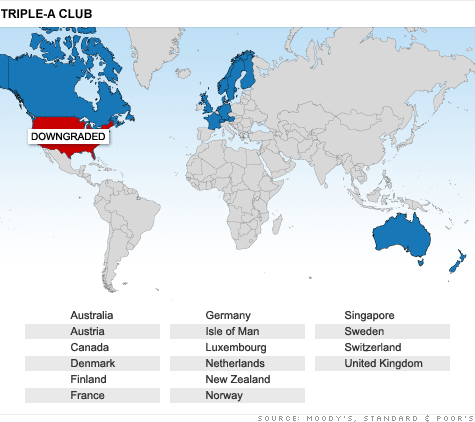 The Triple-A debt club just got even more exclusive: Late Friday, the United States was booted out of a prestigious group of countries that boast a spotless credit rating.
Now only 15 countries (and the very small Isle of Man) hold the triple-A rating from both Standard & Poor's and Moody's.
Canada, France, Germany, Norway, Sweden and Switzerland are among those with the undisputed stamp of approval -- so is Isle of Man, a British crown dependency off the United Kingdom's west coast, and Singapore (both of which are too small to see on our CNNMoney map above.)
The triple-A rating enables nations to borrow funds at a low cost, because their governments are considered stable and their bonds safe. (more)
Friday, 29 July 2011
29/7/11 - Coming Crisis Alert -- America Approaching Debt Default

WARNING AREA AND DURATION:
United States of America, until Monday, August 1st 2011, Midnight EST.
EVENT INFORMATION:
The United States of America is rapidly approaching a sovereign debt default. The inability of America's political parties to reach a debt ceiling deal, and Thursday night's failure to even hold, let alone pass a house bill vote indicate that no solution has yet been reached. As of Thursday Night, the US Treasury will begin announcing its emergency plans. While an American debt default may ultimately not take place as there are still a few days left to reach an agreement, events and signs now indicate there is a possibility of a default occurring. This page will be updated as further negotiations unfold.
EMERGENCY INSTRUCTIONS:
1) Those possessing American financial products of any kind, or equities of any kind, should immediately get in contact with their financial advisers.
2) Those possessing house, car or student loans should immediately contact their financial advisers for further instructions, as a default will significantly affect interest rates.
3) While a US debt default would not be immediately dangerous, the most concerning after effects may be social and civil. Austerity measures may be put into place, and the public response may be less than favourable, as was demonstrated over recent months in Europe. Please stay tuned to your radio or television for information on events of unrest so that you may avoid them.
4) As with emergency events of any kind, entitlement payment programs and supply chains may be temporarily disrupted, so it is recommended to have a reasonable stock of food, water and medicines, as well as any other required safety materials on hand. Being prepared also allows individuals to avoid venturing out more often than needed in order to avoid violent or unpredictable situations.
Thursday, 21 April 2011
21/04/2011 - Federal Borrowing on Pace to Hit Debt Limit in Less Than Week
Wednesday, April 20, 2011
(CNSNews.com) - Federal borrowing is on pace to hit the legal limit on the national debt in less than a week.As set in a law passed by Congress and signed by President Barack Obama on Feb. 12, 2010, the legal limit on the national debt is $14.2940 trillion. As of the close of business Tuesday, according to the Daily Treasury Statement released at 4:00 pm today, the portion of the national debt subject to this legal limit was $14.268365 trillion. (The total national debt, including the portion exempted from the legal limit, was $14.3205 trillion.)
This left the U.S. Treasury with the authority to borrow only an additional $25.635 billion before it hits the statutory debt limit.
On April 4, Treasury Secretary Timothy Geithner sent a letter to Senate Majority Leader Harry Reid (D.-Nev.) in order to warn Congress that the Treasury was approaching the legal debt limit. In an appendix to this letter, Geithner pointed to the rapid pace at which new debt was accumulating.
“On average,” Geithner wrote, “the public debt of the United States increases by approximately $125 billion per month (although there are significant variations from month to month).”
In a 31-day month, $125 billion in new debt works out to an average of $4.03 billion in new debt per day. At that pace, the $25.635 billion in legal borrowing authority the Treasury had left at the close of business on Tuesday would be exhausted in less than seven days.
Geithner’s letter did not spell out the time period he used to determine that the debt increases at approximately $125 billion per month. In fact, according to the official debt figures published by the Treasury itself, the debt has been increasing at a somewhat faster pace than $125 billion per month during the Obama presidency.
On Jan. 20, 2009, the day Obama was inaugurated, the portion of the nation debt subject to the legal limit (a small portion of the debt is exempted from the limit) was $10.568142 trillion. By April 19, 2011, the portion of the national debt subject to the limit had increased to 14.268365 trillion. That means that during the first 821 days of Obama’s presidency the debt increased by $3.700223 trillion—or $4.5 billion per day.
The actual average monthly increase in the debt during Obama’s presidency has been $139.5 billion.
In fact, in the past six days, the debt has increased at a far faster pace than either the $4.03 billion per day average suggested by Secretary Geithner or the $4.5 billion per day that the Treasury has increased the debt since Obama became president. At the close of business last Wednesday, the debt subject to the limit was $ 14.211984 trillion--or $56.381 less than the debt recorded at the close of business Tuesday.
In other words, in the six days of Thursday, Friday, Saturday, Sunday, Monday, Tuesday, the national debt increased $56.381 billion---or almost $9.4 billion per day.
At that pace, the Treasury would exhaust its $25.635 in remaining borrowing authority in less than 3 days.
In his April 4 letter to Sen. Reid, Geithner said the Treasury was then projecting that it would hit the debt limit by May 16.
“The Treasury Department now projects that the debt limit will be reached no later than May 16, 2011,” Geithner wrote. “This is a projection based on the expected level of tax receipts, the timing of our commitments and obligations over the next several weeks, and our judgment concerning the level of cash balances we need to operate.”
Geithner also warned that this projection might change—but not to the advantage of Congress.
“Although these projections could change,” Geithner wrote, “we do not believe that they are likely to change in a way that would give Congress more time in which to act.”
When Treasury is about to reach the debt limit, the Treasury secretary can take certain extraordinary steps to stretch the Treasury’s borrow-and-spending authority. According to Geithner, however, these extraordinary measures would only give the government another $165 billion in borrowing-and-spending room.
That extra room is about what the government would typically borrow in 40 days—using Geithner’s conservative estimate that it borrows an average of $125 billion per month.
Subscribe to:
Posts (Atom)