Rev 6:5-6 And when He had opened the third seal, I heard the third living creature say, Come and see. And I looked, and lo, a black horse. And he sitting on it had a balance in his hand. (6) And I heard a voice in the midst of the four living creatures say, A choenix of wheat for a denarius, and three choenixes of barley for a denarius. And do not hurt the oil and the wine.

This rider represents hunger and famine. The horse he rides is black, a color that describes a famine-racked body.

A scale would be used to measure and carefully dole out food. The denarius was a Roman silver coin equal in value to the daily wage of a working man. There will only be enough food for every day and this will be seen in the financial health of our Global Economy which is due to fail soon.
Showing posts with label New World Currency. Show all posts

Monday, 24 October 2011

24/10/11 - Vatican calls for establishment of ‘central world bank’


ROME – The Vatican called on Monday for the establishment of a “global public authority” and a “central world bank” to rule over financial institutions that have become outdated and often ineffective in dealing fairly with crises. The document from the Vatican’s Justice and Peace department should please the “Occupy Wall Street” demonstrators and similar movements around the world who have protested against the economic downturn. “Towards Reforming the International Financial and Monetary Systems in the Context of a Global Public Authority,” was at times very specific, calling, for example, for taxation measures on financial transactions. “The economic and financial crisis which the world is going through calls everyone, individuals and peoples, to examine in depth the principles and the cultural and moral values at the basis of social coexistence,” it said. It condemned what it called “the idolatry of the market” as well as a “neo-liberal thinking” that it said looked exclusively at technical solutions to economic problems. “In fact, the crisis has revealed behaviours like selfishness, collective greed and hoarding of goods on a great scale,” it said, adding that world economics needed an “ethic of solidarity” among rich and poor nations. “If no solutions are found to the various forms of injustice, the negative effects that will follow on the social, political and economic level will be destined to create a climate of growing hostility and even violence, and ultimately undermine the very foundations of democratic institutions, even the ones considered most solid,” it said. It called for the establishment of “a supranational authority” with worldwide scope and “universal jurisdiction” to guide economic policies and decisions. –Reuters
Rise of the theocratic State: “Catholic ecumenicalism, global currency reform, and a New World political order are not separate, isolated events evolving in different spheres of the world. They are synchronous forces, actively engaged in knitting together the fabric for the emperor’s new clothes…the Vatican’s desire to steer the confluence of the world’s crumbling economic and humanistic political institutions through the Italian moral causeway is perfectly congruent with the papacy’s long-cherished ambition to reside over the modern world’s first theocratic global economic order.”

Friday, 30 September 2011

30/9/11 - Stunning Development: New World Order Silver Coin


This is NOT a coin issued by the U.S. Government, U.S. Mint, Federal Reserve Bank or U.S. Treasury. This is not a North American Union Amero coin. This is intended to be used as currency in the New World Order.


Alan Greenspan:
"In the absence of the gold standard, there is no way to protect savings from confiscation through inflation. ... This is the shabby secret of the welfare statists' tirades against gold. Deficit spending is simply a scheme for the confiscation of wealth. Gold stands in the way of this insidious process. It stands as a protector of property rights. If one grasps this, one has no difficulty in understanding the statists' antagonism toward the gold standard."

James Madison:
"History records that the money changers have used every form of abuse, intrigue, deceit, and violent means possible to maintain their control over governments by controlling the money and its issuance."

Abraham Lincoln:
"I see in the near future a crisis approaching that unnerves me and causes me to tremble for the safety of my country; corporations have been enthroned, an era of corruption in High Places will follow, and the Money Power of the Country will endeavor to prolong its reign by working upon the prejudices of the People, until the wealth is aggregated in a few hands, and the Republic is destroyed. I feel at this moment more anxiety for the safety of my country than ever before, even in the midst of war"

James Paul Warburg:
"We shall have World Government, whether or not we like it. The only question is whether World Government will be achieved by conquest or consent."

Barry Goldwater:
"Most Americans have no real understanding of the operation of the international money lenders. The accounts of the Federal Reserve System have never been audited. It operates outside of the control of Congress and manipulates the credit of the United States."

G. D. McDaniel:
"If, as it appears, the experiment that was called 'America' is at an end ... then perhaps a fitting epitaph would be ... 'here lies America the greatest nation that might have been had it not been for the Edomite bankers who first stole their money, used their stolen money to buy their politicians and press and lastly deprived them of their constitutional freedom by the most evil device yet created --- The Federal Reserve Banking System."

Louis McFadden:
"The Federal Reserve Bank of New York is eager to enter into close relationship with the Bank for International Settlements.... The conclusion is impossible to escape that the State and Treasury Departments are willing to pool the banking system of Europe and America, setting up a world financial power independent of and above the Government of the United States.... The United States under present conditions will be transformed from the most active of manufacturing nations into a consuming and importing nation with a balance of trade against it."


Sunday, 18 September 2011

18/9/11 - Is China Ready To Pull The Plug?


There are two mainstream market assumptions that, in my mind, prevail over all others. The continuing function of the Dow, the sustained flow of capital into and out of the banking sector, and the full force spending of the federal government are ALL entirely dependent on the lifespan of these dual illusions; one, that the U.S. Dollar is a legitimate safe haven investment and will remain so indefinitely, and two, that China, like many other developing nations, will continue to prop up the strength of the dollar indefinitely because it is “in their best interest”. In the dimly lit bowels of Wall Street such ideas are so entrenched and pervasive, to question their validity is almost sacrilegious. Only after the recent S&P downgrade of America’s AAA credit rating did the impossible become thinkable to some MSM analysts, though a considerable portion of the day-trading herd continue to roll onward, while the time bomb strapped to the ass end of their financial house is ticking away.
The debate over the health and longevity of the dollar comes down to one very simple and undeniable root pillar of economics; supply and demand. The supply of dollars throughout the financial systems of numerous countries is undoubtedly overwhelming. In fact, the private Federal Reserve has been quite careful in maintaining a veil of secrecy over the full extent of dollar saturation in foreign markets in order to hide the sheer volume of greenback devaluation and inflation they have created. If for some reason the reserves of dollars held overseas by investors and creditors were to come flooding back into the U.S., we would see a hyperinflationary spiral more destructive than any in recorded history. As the supply of dollars around the globe increases exponentially, so too must foreign demand, otherwise, the debt machine short-circuits, and newly impoverished Americans will be using Ben Franklins for sod in their adobe huts. As I will show, demand for dollars is not increasing to match supply, but is indeed stalled, ready to crumble.
China, being the second largest holder of U.S. debt next to the Fed, and the number one holder of dollars within their forex reserves, has always been the key to gauging the progression of the global economic collapse now in progress. If you want to know what’s going to happen tomorrow, watch what China does today.
Back in 2005, China began a low profile program to issue government debt denominated in the Yuan, called Yuan bonds, or “Panda Bonds”. This move was almost entirely ignored by establishment economists. They should have realized then that China was moving to strengthen the Yuan, expand its use in other markets, and recondition their economic structure away from export dependency and towards consumerism (as they have done with the establishment of the ASEAN trading bloc). Of course, in the MSM at that time, there was no derivatives bubble, no credit crisis, no debt implosion. America was on cloud nine. China, through inside knowledge, or perhaps a crystal ball, knew exactly what was about to happen, and insulated itself accordingly by generating distance between its system and the soon to derail retail based society of the U.S. This dynamic has not changed since the 2008 bubble burst, and Chinese activity is still the ultimate litmus test for economic volatility.
Today, there is widespread confusion in markets over the direction of America’s financial future.In the wake of the credit downgrade, most investors unaware of the bigger picture are desperately clinging to any and every piece of news no matter how trivial, every rumor from the Fed, and every announcement from the government no matter how empty. China’s economic news feeds have been tightly regulated and filtered, even more so than usual (which is cause for concern, in my opinion), while distractions in Europe abound. Let’s take a step by step journey through these issues, and see if we can’t produce some clarity…
U.S. versus EU: A Game Of Hot Potato…To The Death?
The theatrical seesaw between the U.S. and Europe is not only becoming obvious to the most narrow of economic analysts, it is also becoming kind of boring. The entire ordeal has been subversively exploited as a false example of systemic “contagion”, and with purpose; global banks need to convince average Americans and average Europeans that destabilization in one portion of the world will automatically lead to destabilization everywhere. This concept is true only so far as forced globalization and centralization have made it true. That said, the charade has been somewhat effective in conditioning the populace with ideas of collectivist survival. In other words, we are being trained to take fiscal responsibility for countries outside of our sovereign national boundaries as if we are morally tied to every penny they have or do not have (global socialism/feudalism - here we come!). This process is culminating in worldwide harmonization through fear as well as guilt.
What we are witnessing is NOT contagion. Instead, we are seeing multiple and mostly separate collapses activated simultaneously. Each nation suffering dire straights in Europe is doing so because of its own particular financial problems, not the problems of other countries nearby, and certainly not those of countries on the other side of the world. Contagion arguments are only applicable to those economies overly dependent on exports, yet, China has already shown (at least in the case of the U.S.) that such dangers can be controlled by minimizing exposure to the poisoned portions of the system and reverting to more internalized wealth creation.
Treasury Secretary Timothy Geithner and the heads of World Bank and IMF have perpetuated the lie of contagion between the U.S. and the EU primarily to service the progress of globalization, but also to hide the inflationary effects of dollar devaluation. While the greatest threats are stacked squarely against America’s economy and the dollar, somehow we have been led to focus on the comparatively less explosive drama in the EU. U.S. dollars, as well as Chinese funds, are flooding into Europe to support the region, while investment in the U.S. and its debt weakens and disappears. In the meantime, a weaker Euro makes the dollar look more attractive (at least on paper), but in reality, both currencies are on the path to bloody hari-kari.
How much longer can this game of hot potato go on? Again, China decides. Eventually, China is going to have to choose which currency to support; the dollar or the euro. Supporting both is simply not an option, especially when the chance of collapse in both currencies is so high. So far, the most logical path has been the euro. While the EU may suffer an astonishing breakdown, we must take into account that our own Treasury and central bank have seen fit to throw trillions of dollars into propping up Europe (with even more on the way):
With so much inflation and devaluation being thrust upon the dollar in the name of saving the EU, China’s move towards a stronger economic relationship with Europe at the expense of the U.S. is a no-brainer:
If I were to place a bet on who would come out of the crisis less damaged, my money would be on the EU, everyone else’s money certainly seems to be…
China Discreetly Moving To Dump U.S. Debt
China has been tip-toeing towards this for years, and has openly admitted on numerous occasions that they plan to institute a break from U.S. debt and the dollar in due course. Anyone who continues to argue that a Chinese decoupling from America’s economy is impossible at this point is truly beyond hope. Though increasingly more rare, news on China’s push to drop the U.S. still leaks out. Recently, a top advisor to China’s central bank let slip that a plan is in place to begin “liquidating” (yes, they said liquidate) their U.S. Treasury bonds as soon as possible, and reposition national investments into more physical assets:
But let’s step back for a moment and pretend China hasn’t told us exactly what it is going to do time and time again. Instead, let’s look at the fundamentals.
The primary concern in China right now is inflation. Because China does not yet have the ability to export its fiat to other markets the way the U.S. does, its own liquidity injections in the face of the credit crisis have led to severe price increases. In August alone, overall inflation was rated at 6.2% (always double government produced numbers to get true inflation). Food prices jumped 13.4%, while meat and poultry jumped 29.3%. Because these numbers are around 1% lower than in previous months, the Chinese government has prematurely proclaimed a “cooling period”:
With harsh inflation continuing unabated, eventually, the Asian nation will be forced to enact abrupt policies. This will likely take the form of a strong Yuan valuation, or a “floating” of the Yuan. A sizable increase in the value of the Chinese currency is the ONLY way that the government will be able to combat rising prices. By increasing the buying power of its citizens, the government allows them to keep pace with rising prices, and eases the tension within the populace which could otherwise lead to civil unrest. For China to ensure that a floating of the Yuan will lead to a much higher value, their forex and treasury holdings will have to fall. Period.
A dumping of the dollar will give the Chinese room to breath, and this space will be needed very soon. The debt ceiling deal made by Congress in the aftermath of the credit downgrade left the rest of the world unimpressed. While the MSM tries to make us forget that this event ever occurred, most foreign investors have not. Markets are anxiously awaiting an announcement from the Fed for further liquidity injections. If this announcement is not made after meetings next week, then it will certainly be made before the end of the year. Ironically, the same quantitative easing that investors are clamoring for today is liable to become the final signal for China to cut its losses and separate from U.S. securities completely. China has been positioned for many months now to take such measures…
Lights Out…
Delusions of Chinese dependency on the U.S consumer still abound, and those who suggest a catastrophic dump of U.S. debt and dollars in the near term are liable to hear the same ignorant talking points we have heard all along:
“The Chinese are better off with us than without us…”
"China needs export dollars from the U.S. to survive…”
“China isn’t equipped to produce goods without U.S. technological savvy…”
"America could simply revert back to industry and production and teach the Chinese a lesson…”
“The U.S. could default on its debts to China and simply walk away…”
“The whole situation is China’s fault because of their artificial devaluation of the Yuan over the decades…”
And on and on it goes. Though I have deconstructed these arguments more instances than I can count in the past, I feel it my duty to at least quickly address them one more time:
U.S. consumption of all goods, not just Chinese goods, has fallen off a cliff since 2008 and is unlikely to recover anytime soon. China has done quite well despite this fall in exports considering the circumstances. With the institution of ASEAN, they barely need us at all.
China is well equipped to produce technological goods without U.S. help, and if Japan is inducted into ASEAN (as I believe they soon will be), they will be even more capable.
America will NOT be able to revert back to an industrial based economy before a dollar collapse escalates to fruition. It took decades to dismantle U.S. industry and ship it overseas.Reeducating a 70% service based society to function in an industrial system, not to mention resurrecting the factory infrastructure necessary to support the nation, would likely take decades to accomplish.
If the U.S. deliberately defaults on debt to China, the global reputation of the dollar would implode, and its world reserve status would be irrevocably lost. We won’t be teaching anyone a “lesson” then.
Yes, China currently manipulates its currency down, but then again, so does the U.S. though quantitative easing. Both sides are dirty. Taking sides in this farce is pure stupidity...
Now that all that has been cleared up (again), the primary point becomes rather direct; the reason it is difficult to predict an exact time frame for an American collapse is because all the pieces are in place to trigger an event right now! There are, of course, stress points within the system that set a time limit, even on global banks and China, but a full spectrum catastrophe is not only a concern for some distant future. Every element needed for the so called “perfect storm” is ever present and ready to ignite at a moments notice. The destructive potential coming from China alone is undeniable. Everyday that the spark is subdued should be treated as a gift, an extra 24 hours of education and preparation. This is how close we are to the edge.It is not for us to be alarmed, but to be ready, and ever aware.

Friday, 9 September 2011

9/9/11 - China Buying Gold To Crash US Dollar As Reserve


Wondering why gold at $1850 is cheap, or why gold at double that price will also be cheap, or frankly at any price? Because, as the following leaked cable explains, gold is, to China at least, nothing but the opportunity cost of destroying the dollar’s reserve status. Putting that into dollar terms is, therefore, impractical at best, and illogical at worst. We have a suspicion that the following cable from the US embassy in China is about to go not viral but very much global, and prompt all those mutual fund managers who are on the golden sidelines to dip a toe in the 24 karat pool. The only thing that matters from China’s perspective is that “suppressing the price of gold is very beneficial for the U.S. in maintaining the U.S. dollar’s role as the international reserve currency. China’s increased gold reserves will thus act as a model and lead other countries towards reserving more gold. Large gold reserves are also beneficial in promoting the internationalization of the RMB.” Now, what would happen if mutual and pension funds finally comprehend they are massively underinvested in the one asset which China is without a trace of doubt massively accumulating behind the scenes is nothing short of a worldwide scramble, not so much for paper, but every last ounce of physical gold…
From Wikileaks:
3. CHINA’S GOLD RESERVES

“China increases its gold reserves in order to kill two birds with one stone”

“The China Radio International sponsored newspaper World News Journal (Shijie Xinwenbao)(04/28): “According to China’s National Foreign Exchanges Administration China ‘s gold reserves have recently increased. Currently, the majority of its gold reserves have been located in the U.S. and European countries. The U.S. and Europe have always suppressed the rising price of gold. They intend to weaken gold’s function as an international reserve currency. They don’t want to see other countries turning to gold reserves instead of the U.S. dollar or Euro. Therefore, suppressing the price of gold is very beneficial for the U.S. in maintaining the U.S. dollar’s role as the international reserve currency. China’s increased gold reserves will thus act as a model and lead other countries towards reserving more gold. Large gold reserves are also beneficial in promoting the internationalization of the RMB.”
Perhaps now is a good time to remind readers what will happen if and when America’s always behind the curve mutual and pension fund managers finally comprehend that they are massively underinvested in the one best performing asset class.
You already know the basic reasons for owning gold – currency protection, inflation hedge, store of value,calamity insurance – many of which are becoming clichés even in mainstream articles. Throw in the supply and demand imbalance, and you’ve got the basic arguments for why one should hold gold for the foreseeable future.
All of these factors remain very bullish, in spite of gold’s 450% rise over the past 10 years. No, it’s not too late to buy, especially if you don’t own a meaningful amount; and yes, I’m convinced the price is headed much higher, regardless of the corrections we’ll inevitably see. Each of the aforementioned catalysts will force gold’s price higher and higher in the years ahead, especially the currency issues.
But there’s another driver of the price that escapes many gold watchers and certainly the mainstream media. And I’m convinced that once this sleeping giant wakes, it could ignite the gold market like nothing we’ve ever seen.
The fund management industry handles the bulk of the world’s wealth. These institutions include insurance companies, hedge funds, mutual funds, sovereign wealth funds, etc. But the elephant in the room is pension funds. These are institutions that provide retirement income, both public and private.


Global pension assets are estimated to be – drum roll, please – $31.1 trillion. No, that is not a misprint. It is more than twice the size of last year’s GDP in the U.S. ($14.7 trillion).

We know a few hedge fund managers have invested in gold, like John Paulson, David Einhorn, Jean-Marie Eveillard. There are close to twenty mutual funds devoted to gold and precious metals. Lots of gold andsilver bugs have been buying.

So, what about pension funds?

According to estimates by Shayne McGuire in his new book, Hard Money; Taking Gold to a Higher Investment Level, the typical pension fund holds about 0.15% of its assets in gold. He estimates another 0.15% is devoted to gold mining stocks, giving us a total of 0.30% – that is, less than one third of one percent of assets committed to the gold sector.

Shayne is head of global research at the Teacher Retirement System of Texas. He bases his estimate on the fact that commodities represent about 3% of the total assets in the average pension fund. And of that 3%, about 5% is devoted to gold. It is, by any account, a negligible portion of a fund’s asset allocation.

Now here’s the fun part. Let’s say fund managers as a group realize that bonds, equities, and real estate have become poor or risky investments and so decide to increase their allocation to the gold market. If they doubled their exposure to gold and gold stocks – which would still represent only 0.6% of their total assets – it would amount to $93.3 billion in new purchases.

How much is that? The assets of GLD total $55.2 billion, so this amount of money is 1.7 times bigger than the largest gold ETF. SLV, the largest silver ETF, has net assets of $9.3 billion, a mere one-tenth of that extra allocation.

The market cap of the entire sector of gold stocks (producers only) is about $234 billion. The gold industry would see a 40% increase in new money to the sector. Its market cap would double if pension institutions allocated just 1.2% of their assets to it.

But what if currency issues spiral out of control? What if bonds wither and die? What if real estate takes ten years to recover? What if inflation becomes a rabid dog like it has every other time in history when governments have diluted their currency to this degree? If these funds allocate just 5% of their assets to gold – which would amount to $1.5 trillion – it would overwhelm the system and rocket prices skyward.

And let’s not forget that this is only one class of institution. Insurance companies have about $18.7 trillion in assets. Hedge funds manage approximately $1.7 trillion. Sovereign wealth funds control $3.8 trillion. Then there are mutual funds, ETFs, private equity funds, and private wealth funds. Throw in millions of retail investors like you and me and Joe Sixpack and Jiao Sixpack, and we’re looking in the rear view mirror at $100 trillion.

I don’t know if pension funds will devote that much money to this sector or not. What I do know is thatsovereign debt risks are far from over, the U.S. dollar and other currencies will lose considerably more value against gold, interest rates will most certainly rise in the years ahead, and inflation is just getting started. These forces are in place and building, and if there’s a paradigm shift in how these managers view gold, look out!

I thought of titling this piece, “Why $5,000 Gold May Be Too Low.” Because once fund managers enter the gold market in mass, this tiny sector will light on fire with blazing speed.

My advice is to not just hope you can jump in once these drivers hit the gas, but to claim your seat during the relative calm of this month’s level prices.

Tuesday, 16 August 2011

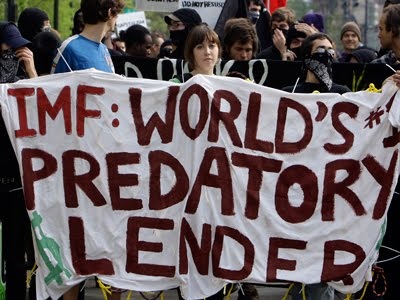
16/8/11 - Six Steps by the IMF for a One-World Currency


Alt-Market
In mainstream financial circles, the concept of a global currency is often spoken of only with anatmosphere of caution. It is approached always in hypothetical terms. It is whispered of as some far off dream; a socio-economic moon landing in the far reaches of fiscal space. Perhaps in 2015, or 2020, or maybe 2050, but certainly never just over the horizon, or right around the corner posing as an innocuous trade asset created over 40 years ago and used only on rare occasions. Unfortunately, the development of a centralized global security representing the creation of a supranational economic body is much closer than many would care to admit…
The most common argument made in the mainstream against a global currency taking shape is the argument that no other currency in the world today has the strength or widespread circulation necessary to replace the dollar as a primary reserve unit. This is true, if, you only look at separate currencies, and not the big picture. The reality is, central banks and the IMF have no intention of replacing one national currency with yet another national currency as the world reserve. What they DO intend to do, however, is replace the dollar with a basket of national currencies linked together and homogenized under a single unit. This has been openly announced by the IMF for months, and Dominique Strauss-Kahn even produced a press release explaining the plan (this was before he apparently watched ‘Maid in Manhattan’ 57 times in a row then allegedly tried to “romance” a cleaning lady, which of course landed him in court):
The G20 has also raised discussion of a global currency and a greater oversight role for the IMF on a number of occasions:
A more in-depth look at the IMF plan for the SDR can be seen in a white paper released at the beginning of this year entitled “Enhancing International Monetary Stability – A Role For The SDR?”:
A global currency, or at least the foundation for one, already exists in the form of “Special Drawing Rights” (SDR’s), created by the IMF in 1969 as paper collateral used to replace gold as the primary means of international trade between governments and central banks without the need for Forex exchanges. That is to say, the SDR was used as a tool for displacing the strength of gold. Today, the asset has morphed into a trade mechanism representing a basket of currencies, and, a tool to displace the U.S. dollar as the world reserve currency.
Skeptics will argue that the SDR is a “long way” from being ready to unseat the dollar, but, these economists and pundits rarely consider that the financial circumstances of markets today could quickly change tomorrow. Yes, by the standards of this very moment, a move to elevate the SDR to reserve status is impractical, mainly, because the dollar is still clinging to its relative value and widespread use. This will not be the case for much longer.
Over the past month, the “big three” ratings agencies; Moody’s, Fitch, and S&P, have suddenly decided to do the job they should have been doing years ago, and have begun a wild roller coaster ride of credit downgrades for countries with immense Debt-to-GDP ratios. Greece has been junked. Ireland has been junked. Portugal has been hit. Spain has been hit, and is ready for yet another downgrade. Italy is on the chopping block. Finally, even the U.S. is near losing its AAA status as S&P has announced it will decide within the next month whether a downgrade of our rating will soon be necessary.
The most important aspect of the S&P announcement is their statement that the downgrade is NOT about the impending debt ceiling decision, but America’s overall creditworthiness and our lack of ability to maintain our current spending and inflationary habits. That is to say, even if the debt ceiling is raised, as all the Keynesians are clamoring for, we could still lose our top credit rating:
This storm of downgrades after years of inaction by ratings agencies, in my view, is simply not a coincidence. The fact that Ben Bernanke has admitted that QE3 is on the table as well after the Fed denied any need for more stimulus only two months ago is also highly suspicious (though he tried to take back the statement later after a thorough grilling from Ron Paul):
The bottom line is that if the ceiling is raised, the Fed is ready to print the dollar into an early grave. If the ceiling is frozen in place, America defaults on its debts and its credit rating evaporates. Either way, the dollar will inevitably lose its world reserve status. Enter the SDR…
What we are witnessing is a careful and deliberate “shuffle” of economic circumstances towards a financial and political environment more receptive to a global currency. Or, indeed, a public so desperate for stability as to have no other choice but a global currency. Here are some of the steps that will likely take place and in certain cases must take place before the SDR is able to fulfill the role the IMF intends. Many of these steps are already being implemented as this is written:
1) The IMF Must Increase Circulation Of SDR’s
The normal restrictions on SDR printing were removed in 2008 by the IMF just as the credit crisis began to take shape under the guise of “producing more liquidity”. SDR’s can now be created in unlimited numbers. Allocations of SDR’s by IMF member countries leaped in 2008 to 2009. America’s holdings of SDR’s grew from 21 billion to 203 billion in the span of a single year:
Using the “SDR Department”, the IMF has also been issuing SDR’s to emerging market countries and needy nations off the books, at the expense of the American taxpayer! Rich countries like the U.S. pay into the SDR Department program which is supposedly designed to redistribute “foreign aid” to poorer countries as low interest loans denominated in SDR’s. These loans show up nowhere on our Federal Budget:
In 2004, the cost of paying into this program was around $5 Billion a year, but this has surely been expanded since. Finding accurate numbers on current U.S. loans through the hidden SDR Department program has proven difficult, to say the least…
The point of all this? The SDR is being widely circulated under various operations, some of them public, some of them not so public.
2) Standardized Exchange Tables For The SDR Must Be Put In Place
The IMF now releases daily conversion and exchange tables to SDR’s for almost every other currency on the planet:
One important aspect of SDR conversion to take note of is that the currencies most highly valued on global forex markets, and the SDR table, are the Bahraini Dinar, and the Kuwaiti Dinar. The Bahraini Dinar is pegged directly to the SDR basket, while the Kuwaiti Dinar is pegged to “an undisclosed basket of currencies” (probably the SDR). The dollar, on the other hand, is relatively weak in comparison when converting to SDR’s, even though most of the IMF’s funding, and thus ability to create SDR’s, comes from the U.S.
Doesn’t seem fair, does it…?
Another important fact to remember is that the IMF admittedly sets the valuation of the SDR using factors outside of natural supply and demand. Meaning, they have the ability to place any value they please on the SDR versus other currencies. It is no surprise then that currencies which tie themselves to the IMF basket and placate IMF desires are rated strong in SDR’s, and perform well in forex markets, while the dollar, which remains (supposedly) independent, is weak versus SDR’s. Today, one dollar is worth 62 cents in SDR’s.
3) The SDR Must Be Made Indispensable To Global Markets
The IMF has openly suggested that the SDR could be used as an intermediary asset in volatile currency markets through what is sometimes referred to as a “Substitution Account”. Meaning, if China, for example, wished to dump their holdings of U.S. dollars because they are devaluing rapidly, they could exchange those dollars for SDR’s instead of directly converting them into another standard currency, like Euros, or Yen. This, according to the IMF, would lessen the direct damage to the Dollar, because the SDR is partly denominated in dollars. Therefore, as China throws out dollars in exchange for SDR’s, the value of the American Greenback goes down, but conversely, the value of America’s SDR holdings will go up.
This sounds like a brilliant strategy to offset sudden currency collapse. However, it is actually a very subversive way to slowly elevate the SDR as a world reserve currency itself, and to replace the dollar entirely, while the IMF plays the hero. It also allows the IMF to slowly “harmonize” all the world’s currencies until there is no distinction in their value. The SDR becomes a de facto reserve unit without officially overthrowing the dollar.
If the U.S. is faced with the nightmare of having its own currency dumped by international central banks, obviously, our Treasury would jump at the chance to support conversion to the SDR to lessen the damage, rather than face the full brunt of losing our reserve status. In fact, the U.S. would have NO CHOICE but to support the SDR and the IMF as the intermediary in all global financial transactions, otherwise, we would face certain long term full spectrum collapse. The only support holding up our financial system would then be our membership in the SDR basket. We would become completely dependent, and the IMF would have total centralized control over our economy.
What the IMF has done is create a potential environment in which any country that does not participate in SDR exchange will be left in the dust by every country that does. They have conjured an artificial economic matrix, where traditional laws of supply and demand no longer apply. A kind of “manipulated evolution” of finance. A chimera economy. They will have the power to determine the value of every currency on the planet arbitrarily using the SDR Substitution Account.
4) China Must Be Given Membership In The SDR
Right now, it appears, the only thing holding the SDR back from its debut as a global currency asset is the inclusion of emerging markets into the IMF basket. Talk of China joining the basket in 2015 has been floating around for the past couple years. However, I believe that the inclusion of the Chinese Yuan may come much faster than this.
New IMF Managing Director, Christine Lagarde, has offered China a greater role in the IMF power structure, including a post for Min Zhu, a Chinese national, as a deputy managing director:
Lagarde and members of the G20 have also been pressing hard for the addition of the Yuan and perhaps other currencies into the SDR. A decision on Chinese inclusion may come as soon as this November:
5) China Must Decouple Completely From The Dollar
One of the points of contention over Chinese inclusion in the SDR is its ties to the U.S. dollar and economy. That is to say, China would first have to decouple from the dollar, before coupling to the SDR. Its sounds like some weird parasitic experiment, and, it is.
China started taking steps to make decoupling from the U.S. and the dollar a reality back in 2005 (which suggests foreknowledge of collapse), when they began issuing Yuan denominated bonds (to circulate Yuan around the world), and, when they began converting away from an export based economy and towards a consumer based economy. The problem is that because of the wider circulation of Yuan, the increase in stimulus, and the Chinese refusal (so far) to allow faster currency appreciation, China is now in the midst of a double digit inflationary crisis (that’s REAL inflation folks, not fraudulent Chinese CPI numbers):
Because they have deliberately restructured towards a consumer based economy, eventually, China will have to allow the Yuan to increase substantially in value versus other currencies in order to amplify the buying power of its citizens. Otherwise, they will be crushed under the weight of rising prices:
This cannot be done without a considerable dump of their forex reserves and treasury holdings, most of which are composed of U.S. dollars and securities. This means that in order to counter inflation, and to be included in the SDR, China will have to liquidate a large portion of its U.S. holdings. This would strike the American economy hard.
6) The Dollar Must Be Removed As The World Reserve Currency
All of the above factors are leading towards one obvious conclusion; the end of the dollar as a reserve currency. The IMF will never achieve its goal of complete centralized administration of the global economywithout a common supranational currency unit. And, a supranational currency unit cannot exist while the dollar remains in its current position. Thus, for the IMF to succeed, the dollar must be removed.
The expansive debt of the U.S., the endless fiat printing of the Federal Reserve, the Chinese adaptation away from the dollar and towards the SDR, and the quiet spread of the SDR itself, are all leading to this end. This does not mean, though, that the tangible version of the dollar will disappear. The interesting thing about the SDR con game is that many Americans may barely notice the transition of the global economy into IMF hands, because physical dollars will likely remain. We might feel the heartache of a devaluing monetary system, and an extremely weakened economy, but the flow of power will be obscured for a time from those who are unaware. In the end, all currencies will be tied to and completely reliant on the SDR, but our Greenback funny money will still be in our pockets. The issuance of an “SDR note” may come one day (if we allow this farce to continue), but it is not necessary. As long as every currency is required to be pegged to the SDR, the IMF will retain control.
A common assumption is that changes like these take place in some distant future we will never witness, not right under our noses while we sleep. The current evidence suggests, though, that an engineered transference to a highly condensed global economic system is underway right now, and that our country will suffer greatly in the process. To understand the tactically implemented disaster we are about to experience, it is vital to become aware of the intended end result. Just as in understanding any criminal act, it is vital to first understand a criminal’s ultimate motive.

Thursday, 11 August 2011

11/8/11 - UN wants new global currency to replace dollar

The dollar should be replaced with a global currency, the United Nations has said, proposing the biggest overhaul of the world's monetary system since the Second World War.
Crumpled dollar bill - UN wants new global currency to replace dollar
A number of countries, including China and Russia, have suggested replacing the dollar as the world's reserve currency 
In a radical report, the UN Conference on Trade and Development (UNCTAD) has said the system of currencies and capital rules which binds the world economy is not working properly, and was largely responsible for the financial and economic crises.
It added that the present system, under which the dollar acts as theworld's reserve currency , should be subject to a wholesale reconsideration.
Although a number of countries, including China and Russia, have suggested replacing the dollar as the world's reserve currency, the UNCTAD report is the first time a major multinational institution has posited such a suggestion.
In essence, the report calls for a new Bretton Woods-style system of managed international exchange rates, meaning central banks would be forced to intervene and either support or push down their currencies depending on how the rest of the world economy is behaving.
The proposals would also imply that surplus nations such as China and Germany should stimulate their economies further in order to cut their own imbalances, rather than, as in the present system, deficit nations such as the UK and US having to take the main burden of readjustment.
"Replacing the dollar with an artificial currency would solve some of the problems related to the potential of countries running large deficits and would help stability," said Detlef Kotte, one of the report's authors. "But you will also need a system of managed exchange rates. Countries should keep real exchange rates [adjusted for inflation] stable. Central banks would have to intervene and if not they would have to be told to do so by a multilateral institution such as the International Monetary Fund."
The proposals, included in UNCTAD's annual Trade and Development Report , amount to the most radical suggestions for redesigning the global monetary system.
Although many economists have pointed out that the economic crisis owed more to the malfunctioning of the post-Bretton Woods system, until now no major institution, including the G20 , has come up with an alternative.