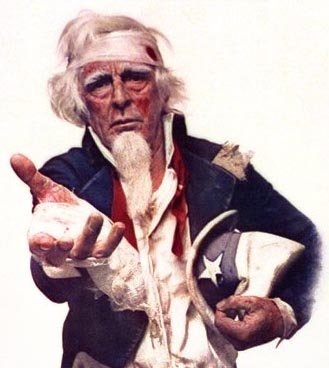
Rev 6:5-6 And when He had opened the third seal, I heard the third living creature say, Come and see. And I looked, and lo, a black horse. And he sitting on it had a balance in his hand. (6) And I heard a voice in the midst of the four living creatures say, A choenix of wheat for a denarius, and three choenixes of barley for a denarius. And do not hurt the oil and the wine.

This rider represents hunger and famine. The horse he rides is black, a color that describes a famine-racked body.

A scale would be used to measure and carefully dole out food. The denarius was a Roman silver coin equal in value to the daily wage of a working man. There will only be enough food for every day and this will be seen in the financial health of our Global Economy which is due to fail soon.

Tuesday, 17 May 2011

16/5/11 - World on course for next crisis, warns Gordon Brown

The global economy is heading towards another meltdown despite the lessons of the last financial crisis, Gordon Brown has warned.

The global economy is heading towards another meltdown despite the lessons of the last financial crisis, Gordon Brown has warned.
Mr Brown said the "resolve" to act seen immediately after the crisis has been replaced by indecision and vested interest. Photo: PA
The former prime minister said that unless leaders take more action, the recent credit crunch could prove just the "trailer" to a string of crises.
"In 2008, when we were hours away from ATMs running out of money, small businesses being unable to pay their staffs, and schools and hospitals closing down through lack of cash flow, it felt as if the crisis of the century was upon us," he wrote in US magazine Newsweek.
"But if the world continues on its current path, the historians of the future will say that the great financial collapse of three years ago was simply the trailer for a succession of avoidable crises that eroded popular consent for globalisation itself.
"Those who believe that the world has learned from the mistakes that led to the crash are mistaken."
Mr Brown said the "resolve" to act seen immediately after the crisis has been replaced by indecision and vested interest. He urged politicians at the next G20 summit, which takes place in Cannes in November, to take control of a globalised financial system which is still "perilously" unregulated.
Mr Brown's comments come amid repeated warnings by European policy-makers that the debt crisis surrounding the eurozone's weaker nations could have a worse systemic effect on global markets than the collapse of the investment bank Lehman Brothers in 2008, which precipitated the last crisis.
They fear "with good cause" that if Greece has to restructure its debt - effectively default - it could unravel a chain of trades based on the problematic debt and lay bare the interconnectedness of institutions around the world, said Stephen Lewis, an analyst at Monument Securities.

Friday, 13 May 2011

14/5/11 - Crisis after Crisis = COLLAPSE

Saturday, 14 May 2011 12:01
Charlie McGrath
Wide Awake News
May 13th, 2011

www.theinternationalforecaster.com/International_Forecaster_Weekly/The…
www.zerohedge.com/article/centrist-think-tank-conducts-study-finds-us-…

13/5/11 - World to Suffer a New Currency Crisis by Fall


China threatens 'nuclear option' of dollar sales

Fistful of dollars - China threatens 'nuclear option' of dollar sales
Fistful of dollars - China's trade surplus reached $26.9bn in June 
The Chinese government has begun a concerted campaign of economic threats against the United States, hinting that it may liquidate its vast holding of US treasuries if Washington imposes trade sanctions to force a yuan revaluation.
Two officials at leading Communist Party bodies have given interviews in recent days warning - for the first time - that Beijing may use its $1.33 trillion (£658bn) of foreign reserves as a political weapon to counter pressure from the US Congress.
Shifts in Chinese policy are often announced through key think tanks and academies.
Described as China's "nuclear option" in the state media, such action could trigger a dollar crash at a time when the US currency is already breaking down through historic support levels.
It would also cause a spike in US bond yields, hammering the US housing market and perhaps tipping the economy into recession. It is estimated that China holds over $900bn in a mix of US bonds.
Xia Bin, finance chief at the Development Research Centre (which has cabinet rank), kicked off what now appears to be government policy with a comment last week that Beijing's foreign reserves should be used as a "bargaining chip" in talks with the US.
"Of course, China doesn't want any undesirable phenomenon in the global financial order," he added.
He Fan, an official at the Chinese Academy of Social Sciences, went even further today, letting it be known that Beijing had the power to set off a dollar collapse if it choose to do so.
"China has accumulated a large sum of US dollars. Such a big sum, of which a considerable portion is in US treasury bonds, contributes a great deal to maintaining the position of the dollar as a reserve currency. Russia, Switzerland, and several other countries have reduced the their dollar holdings.
"China is unlikely to follow suit as long as the yuan's exchange rate is stable against the dollar. The Chinese central bank will be forced to sell dollars once the yuan appreciated dramatically, which might lead to a mass depreciation of the dollar," he told China Daily.
The threats play into the presidential electoral campaign of Hillary Clinton, who has called for restrictive legislation to prevent America being "held hostage to economic decicions being made in Beijing, Shanghai, or Tokyo".
She said foreign control over 44pc of the US national debt had left America acutely vulnerable.
Simon Derrick, a currency strategist at the Bank of New York Mellon, said the comments were a message to the US Senate as Capitol Hill prepares legislation for the Autumn session.
"The words are alarming and unambiguous. This carries a clear political threat and could have very serious consequences at a time when the credit markets are already afraid of contagion from the subprime troubles," he said.
A bill drafted by a group of US senators, and backed by the Senate Finance Committee, calls for trade tariffs against Chinese goods as retaliation for alleged currency manipulation.
The yuan has appreciated 9pc against the dollar over the last two years under a crawling peg but it has failed to halt the rise of China's trade surplus, which reached $26.9bn in June.
Henry Paulson, the US Tresury Secretary, said any such sanctions would undermine American authority and "could trigger a global cycle of protectionist legislation".
Mr Paulson is a China expert from his days as head of Goldman Sachs. He has opted for a softer form of diplomacy, but appeared to win few concession from Beijing on a unscheduled trip to China last week aimed at calming the waters.

Tuesday, 10 May 2011

10/5/11 - U.S. ‘Underwater’ Homeowners Increase to 28 Percent

Negative Housing Equity Increases
Rows of houses stand in Las Vegas in an aerial photo taken on Sept. 22, 2009. Homeowners with negative equity increased to 28 percent nationwide from 22 percent a year earlier, according to Zillow Inc. Photographer: Jacob Kepler/Bloomberg 

More than 28 percent of U.S. homeowners with mortgages owed more than their properties were worth in the first quarter as values fell the most since 2008, Zillow Inc. said today.

Homeowners with negative equity increased from 22 percent a year earlier as home prices slumped 8.2 percent over the past 12 months, the Seattle-based company said. About 27 percent of homes with mortgages were “underwater” in the fourth quarter, according to Zillow, which runs a website with property-value estimates and real-estate listings.

Home prices fell 3 percent in the first quarter and will drop as much as 9 percent this year as foreclosures spread and unemployment remains high, Zillow Chief Economist Stan Humphries said. Prices won’t find a floor until 2012, he said.

“We get tired of telling such a grim story, but unfortunately this is the story that needs to be told,” Humphries said in a telephone interview. “Demand is still quite anemic due to unemployment and the fact that home values are still falling. And that tends to make people more cautious about buying.”
The U.S. unemployment rate rose to 9 percent in April, up from 8.8 percent in March, the Department of Labor reported May 6. Home prices have fallen almost 30 percent from their June 2006 peak, wiping out more than $10 trillion in equity, including $667.5 billion in the first quarter, Humphries said.

Dropping Home Values

Other analysts also expect homes to continue losing value this year. Oliver Chang of Morgan Stanley expects prices to fall as much as 11 percent, according to an April 25 report. Prices may fall “another 5 or 10 percent,” Robert Shiller, an economics professor at Yale University, told Fox Business on April 26. Home prices were 33 percent below the July 2006 peak in February, according to the S&P/Case-Shiller Composite 20-City Home Price Index, co-created by Shiller.

Prices will continue falling as more houses are lost to foreclosure, flooding the market with distressed properties, Humphries said.

Foreclosures fell to the lowest level in three years in the first quarter as lenders worked through a backlog of flawed paperwork, according to RealtyTrac Inc., an Irvine, California- based real estate information service. Foreclosure filings are likely to jump 20 percent this year, reaching a peak for the housing crisis, RealtyTrac predicted in January.

The number of homes with negative equity rose to 16.2 million in the first quarter from 13.1 million a year earlier, Zillow said.
Las Vegas Highest

In Las Vegas, 85 percent of homes with mortgages were underwater, the most of any city tracked by Zillow. Other metropolitan areas in the top five were Reno, Nevada, at 73 percent; Phoenix at 68 percent; and Modesto, California, and Tampa, Florida, both at 60 percent. Zillow has tracked negative equity since the first quarter of 2009, when more than 22 percent of homes were underwater.

Property values rose in only three of the 132 regions tracked by Zillow: Fort Myers, Florida, where they gained 2.4 percent; Champaign-Urbana, Illinois, up 0.8 percent; and Honolulu, up 0.3 percent. Fort Myers prices increased after falling more than 60 percent from their 2006 peak because they “over-corrected,” Humphries said.

The first quarter’s U.S. home price decline was the steepest since the fourth quarter of 2008, when prices fell 3.9 percent, according to Zillow data. Values dropped almost 13 percent over the course of that year.
“It’s not going to be as bad as 2008,” Humphries said. “But it’s going to be worse than we thought it was going to be.”

‘Stealing Demand’

Prices were propped up in 2009 and early 2010 by federal stimulus programs, such as tax credits worth up to $8,000 for first-time homebuyers, Humphries said. That program “was stealing demand from the future,” weakening shoppers’ appetites now even as housing affordability is at its three-decade high, he said.
“In the past, people felt more bullish in a post-recession recovery,” he said. “They’d go out and spend more on homes and that would ignite hiring in construction and the mortgage industry. And they’d start to get the flywheel moving more quickly. Unfortunately, now, that flywheel is broken.”

Thursday, 5 May 2011

5/5/11 - What Is The Best Place To Live In The United States To Prepare For The Coming Economic Collapse?

The Economic Collapse
What is the best place to live in the United States?  I get asked that question all the time.  My answer can be summed up in two words: it depends.  The truth is that the answer is going to be different for each person.  All of us have different goals and different needs.  If you have a very strong network of family and friends where you live right now, you might want to think twice before moving hundreds or thousands of miles away.  If you have a great job where you live right now, you might want to hold on to it.  You should not just assume that you are going to be able to pick up and move to another part of the country and be able to get a similar job right away.  The United States is in the midst of a very serious economic decline right now, and wherever you live you are going to have to provide for your family.  Just because you move somewhere new does not mean that you are going to leave your problems behind.  In fact, you might find that they moved right along with you.  With all that being said, the reality is that there are some places in the U.S. that are going to be much more desirable than others when the economy totally falls apart.  For example, during a total economic collapse it will not be good to be living in a large city or in a densely populated area.  Just think about what happened in the aftermath of Hurricane Katrina.  If the entire nation is going through something like that, you don’t want to have hundreds of thousands of close neighbors at that point.  So when thinking about where you want to be when everything falls apart, population density should be a major factor.  But there are other factors as well and no area of the United States is perfect.

If you live in or near a major city right now, that is okay.  Most Americans do.  Even if you have limited financial resources at the moment, you can start developing a plan that will get you where you eventually want to go.  If you want to move to another part of the country you can start applying for jobs out there.  You can also be working hard to develop a business that would enable you to move.  Perhaps you have friends or family in more isolated areas that would allow you to stay with them during an economic collapse.
Those that possess more financial resources could start thinking about getting a second home in a location that is more rural.

The key is to come up with a plan and to be working towards accomplishing that plan.
If you don’t have a plan yet, hopefully the following information will give you something to think about.  Not all areas of the United States are equal, and all of them do have problems.
The following are some thoughts about the best place to live in the United States….

The Northeast
A major problem with the Northeast is that it is just so darn crowded.  Yes, there are some rural areas, but the overall population density of the region is so high that it would be really hard to go unnoticed for long in the event of a major economic collapse.

Another thing that is not great about the Northeast is that so much of the population lives near the coast.  As we saw in Japan recently, living near a coastline is not necessarily a good thing.  While it is likely safer to live along the east coast then the west coast, the truth is that there is an inherent level of insecurity when it comes to living in coastal areas.  You never know when the next hurricane, oil spill or tsunami is going to strike.
Also, the Northeast is really quite cold.  So staying warm and growing your own food would be more difficult than in some other areas of the country.

The Mid-Atlantic
The Mid-Atlantic is one of the most beautiful areas of the nation.  Unfortunately, it suffers from many of the same problems that the Northeast does.
The Mid-Atlantic has a very high population density.  For example, the area around Washington D.C. is pretty much all suburbs for 50 miles in all directions.
The weather is nicer than in the Northeast and there are some less dense areas once you get south of Washington D.C.

If you think that the Mid-Atlantic might be for you, you might want to check out North Carolina or South Carolina.  The people tend to get friendlier the further south you go and there are definitely some areas that could potentially work.

Florida
Florida is generally not going to be a place that you want to be during an economic collapse.  The housing market has absolutely collapsed down there and the crime rate is already very high.  It is also very densely populated.

The weather is very nice down in Florida, but one big thing that you need to consider when it comes to Florida is the fact that it is very flat and most of Florida is just barely above sea level.  In fact, quite a bit of Florida is actuallybelow sea level.

In addition, hurricanes are always a major threat in Florida.  It is a beautiful state, but there is a lot of risk to living down there.

The Southeast
The Southeast has really taken a pounding over the last few years.  First it was Hurricane Katrina, and then it was the BP oil spill and then it was the tornadoes of 2011.
There is a lot of poverty in that area of the country.  There is also a lot of crime.
There are a lot of great people who live down in the Southeast, but if you do not know your way around it can be a very difficult place to move to.

The Mid-South
One of my favorite places east of the Mississippi River are the mountains along the Tennessee/North Carolina border.  If you must be in the eastern half of the United States, that is not a bad choice.
Where you do not want to be is anywhere near the New Madrid fault zone.  The New Madrid fault zone covers portions of Illinois, Indiana, Missouri, Arkansas, Kentucky, Tennessee and Mississippi.  The biggest earthquakes in the history of the United States were caused by the New Madrid fault. Many are convinced that we are going to see an absolutely catastrophic earthquake along the New Madrid fault at some point.
So if you want to live in the Mid-South, it is highly recommended that you stay far away from the New Madrid fault zone.

The Upper Midwest
The Upper Midwest was once one of the great manufacturing regions of the world, but now much of it is known as the “rust belt”.

Formerly great manufacturing cities such as Detroit are now absolutehellholes.  Tens of thousands of our factories and millions of our jobs have been shipped overseas.

There are some really great people (including some good friends of this column) that live up there, but the truth is that the region is really cold and unemployment is rampant.

The Upper Midwest is an area that people want to get out of.  It is probably not a great place to move to.
However, if you do need a job, one place to look is a little bit west of there.  Thanks to an abundance of natural resources, unemployment in North Dakota and South Dakota is very low.  If you really need a job you might want to look into those two states.

The Southwest
In the Southwest there are a whole lot of freedom-loving Americans, the weather is very warm and there is a lot of space to get lost.

However, the Southwest is also very dry and in many areas there is not a lot of water.  Drought and wildfires are quite common.

In addition, illegal immigration is rampant and is a constant security threat.
If you are familiar with that area of the country it is not a bad choice, but if you do not know what you are doing it could end up being disastrous for you.

The Great Plains
As long as you are far enough away from the New Madrid fault, the Great Plains is not a bad choice.
It is very, very flat out there, and it can be quite windy, but the good news is that you should be able to grow your own food.
In addition, the population density is generally very low in most areas.
One big negative, as we have seen recently, is tornadoes.  The United States experiences more tornadoes that anywhere else in the world, and “tornado alley” generally gets the worst of it.

The West Coast
During an economic collapse, the West Coast is not a place that you will really want to be.  Just take a look at the state of California already.  It is aneconomic nightmare.
Millions of people have left California over the past couple of decades.  The millions of people that have left have been replaced mostly with illegal aliens.
Oregon is better, although they have very high taxes and they are experiencing huge economic problems right now as well.

The best area along the West Coast is the Seattle area, but you won’t want to be anywhere near a major population center when things totally fall apart.
Also, the West Coast lies along the “Ring of Fire“.  Considering what just happened in Japan and what has been happening in other areas along the Ring of Fire lately, the West Coast is not an area that a lot of people are recommending.

The Northwest
Large numbers of freedom-loving Americans have been moving to the states of Montana, Idaho and Wyoming.  You can also throw eastern Washington and eastern Oregon into this category as well.
It gets cold up in the Northwest, but not as cold as the Upper Midwest.  There are lots of rivers, streams and lakes and in certain areas there is plenty of rain.
The population density is very low in most areas and there is an abundance of wildlife.  Housing prices are reasonable and in many areas you can grow your own food.
The Northwest is one of the favorite areas of the United States for preppers.  It is far from perfect, but it does have a lot of advantages.

Alaska And Hawaii
Neither Alaska or Hawaii is recommended.  Alaska lies along the “Ring of Fire” and it is very, very cold.  Also, almost everything has to be either shipped or flown into Alaska.  In the event of a real economic collapse, supplies to Alaska could be cut off and shortages could develop very quickly.
Hawaii has a huge population and it does not have a lot of room.  Like Alaska, most supplies have to be either shipped in or flown in.  And one really bad tsunami could pretty much wipe Hawaii out.
But once again, there is no “right answer”.  There are areas of just about every U.S. state that could potentially work well during a major economic collapse.

When assessing where “the best place to live in the United States” is, it is important to examine your own personal factors.  What will work for me and for my family will not necessarily work for you and your family.
So what do all of you think about this list?  Which area of the country do you think is best for those Americans who are seeking to prepare themselves for the coming economic collapse?

Tuesday, 3 May 2011

3/5/11 - America appears to be sleepwalking towards disaster – does no one care?

America appears to be sleepwalking towards disaster – does no one care?

So let me get this straight. The Standard and Poor's rating agency last week took the historic step of putting the US government's AAA credit rating on "negative watch".

America appears to be sleepwalking towards disaster ? does no one care?
America appears to be sleepwalking towards disaster ? does no one care? 
There is now, according to S&P, "at least a one in three chance" that American debt will be downgraded from its top-notch status over the next two years – which would be a first in modern times.
A New York Times/CBS News opinion poll has also suggested the US public is now more economically pessimistic than at any time since President Barack Obama's first two months in office in early 2009 – when the country was still caught in the "Great Recession".
Amid renewed talk of a "jobless recovery", the number of Americans who think the economy has deteriorated spiked by 13 percentage points over the past month. Congress, meanwhile, is locked in a bitter dispute over the federal government's ability to make ends meet.
These are the stark realities facing the world's largest economy. They are set, furthermore, against Europe's sovereign debt turmoil, Japan's nuclear crisis and ongoing violence in the Middle East.
Yet despite all this bad news, this veritable litany of woe, the Dow Jones Industrial Average ended last week at a three-year high. US equities are now at levels not seen since mid-2008 – before the credit crunch really took hold. On top of that, despite S&P's announcement, the price of Treasuries kept rising, as their yield – the cost the US government must pay to borrow – fell to its lowest level in a month. Has the world gone mad?
With a federal deficit close to 10pc of GDP, it is clear the US needs some very significant fiscal tightening. Total debts matter even more than annual deficits and on that score America is almost uniquely "in the hole" – with liabilities, including Medicare, Medicaid and social security obligations, amounting to around $75,000bn (£45,000bn), or a stunning five times annual GDP.

It is a testament to the delusion – and plain dishonesty – which surrounds America's fiscal debate that this figure is not more widely cited. Almost all US politicians and pundits spout the official line that sovereign debts are 59pc of national income, rather than 500pc. But, then again, their

UK equivalents maintain that our national debt is 76pc of GDP – again, a fraction of the genuine total.
Earlier this month, Republican Congressman Paul Ryan published a fiscal consolidation strategy document which demonstrated, rather cogently, that the US simply cannot afford its ongoing "entitlement program". Among the very first attempts by a Capitol Hill insider seriously to address America's staggering debts, the Ryan plan is one reason why fiscal consolidation is now set to become the core issue of the 2012 Presidential election campaign.

Another reason is this latest move by S&P. The ratings agency's move was clearly a big moment – but a political moment, having little to do with finance. S&P didn't tell the markets anything they didn't already know about America's fiscal position. US Treasuries are, by a considerable margin, the world's most
closely-watched asset class.

Markets reacted the way they did, though, due to the widely-adopted assumption that the danger of a genuine downgrade will galvanise America's deeply partisan law-makers into action, provoking the requisite banging of political heads. So some kind of deal on budget consolidation now, apparently, looks one step nearer – supposedly making Treasuries more attractive.

Equities rallied, meanwhile, in part because of relatively strong earnings chalked up by the likes of Apple and General Electric. But there was also a feeling that if fiscal consolidation really is now in the works, the US Federal Reserve is more likely to go easy on the monetary side – further delaying the moment when it finally raises interest rates above 0.25pc, the level at which they've languished since December 2008.
Many have commented that the most remarkable aspect of S&P's announcement is that it didn't come earlier. After all, America's public finances have been spiralling out of control for several years. Even more remarkable, though, at least to my mind, was the extent to which S&P's move appeared to be choreographed between the ratings agency – supposedly an ultra-independent body – and the US government.
This crucial announcement was made on Monday April 18. Congress was away for Easter recess, with members scattered across America and beyond. As a result, there were no protesting speeches in the Senate or House of Representatives and no resulting press conferences. The date that S&P picked, however it picked it, was very kind to the White House.

The S&P report itself was also extremely benign. There was no mention that the Obama administration has increased federal spending by more than 30pc in two years, while almost allowing the government to "shut down" by not agreeing to minuscule spending cuts.

In addition, Tim Geithner, US Treasury Secretary, appeared to know about the announcement in advance. Last Sunday, the day before publication, he made himself very available to the broadcast media, touring the TV studies to give multiple interviews on the bold steps being taken by the Obama administration to "tackle the deficit". This allowed the government to, as spin doctors say, "get ahead of the news".

Once the announcement was made, Geithner merely shrugged it off. His official response was that there is "no chance" of S&P's negative outlook turning into an actual downgrade. The rational reaction to such a statement is that "there was no chance of the Titanic sinking either". The more realistic response, perhaps, is to realise that there really is "no chance" of a major US ratings agency gainsaying the White House any time soon.
One reason is that said agencies could yet be fingered by the authorities as the major culprits in the "sub-prime crisis" – and until that danger has passed, they'll do as they're told. The government could, after all, regulate them into non-existence. As the celebrated American comedian Lily Tomlin once uttered: "No matter how cynical you become, it's never enough to keep up."

While the Ryan plan and S&P's announcement means America's fiscal debate is now centre stage, investors should remember that neither event guarantees anything remotely resembling meaningful fiscal retrenchment. And, again, I'm afraid S&P's missive presents it as an apologist for, rather than a critic of, US fiscal largesse.
"The US dollar is the world's most used currency, providing America with unique external flexibility," the report purrs. "Recent depreciation of the currency has not materially affected this position, and we do not expect this to change in the medium term."

This looks suspiciously to me like a ratings agency providing almost an endorsement of quantitative easing – the Fed's $2,300bn programme of "virtual" money printing. I may be wrong, and Lily Tomlin too, but with QE set to end in June, and Fed boss Ben Bernanke hosting a historic press conference this coming week, part of a new regime of "transparency", the US government is desperate for reasons to justify why the printing presses can be kept running up to the Presidential election and beyond.

There's been a lot of talk that S&P's bold move last week was a harbinger of renewed fiscal discipline, not just in the US, but across the Western world. The ratings agency, we're told, "is doing its job" and "holding politicians to account". I would like to think that's true, but I just don't. The gold market doesn't either. The yellow metal, the ultimate hedge against inflation and dollar debasement, hit yet another all-time high last week.

3.5.11 - America's reckless money-printing could put the world back into crisis

Last week, Ben Bernanke suggested that the US base interest rate will stay close to zero for an "extended period". It's been there since December 2008.

America's reckless money-printing could put the world back into crisis
The US currency has also been falling pretty steadily since the summer of 2010, after Ben Bernanke gave the first inklings he would launch QE2. Photo: AP
Traders took these words to mean that the Federal Reserve won't hike rates until the first few months of 2012 at the earliest.
Bernanke also pledged to do whatever is required to keep America's economic recovery on track – confirming that the second programme of "quantitative easing", or QE2, would be completed. These two related announcements – the "reprieve" and the "sugar rush" – sent Wall Street into renewed spasms of synthetic joy.
In the real world, US growth is slowing sharply. Annualised GDP rose just 1.8pc during the first three months of 2011, down from 3.1pc the quarter before. America remains mired in sovereign, commercial and household debt.
Yet as the Fed chairman spoke, US stocks hit their highest level since before the sub-prime crisis. The tech-heavy Nasdaq, incredibly, closed at a 10-year peak.
So the Fed will keep on "printing" virtual money – at least for now. By the end of June, it will have purchased $600bn (£363bn) of longer-term Treasuries, with the US government effectively buying its own debt from funds created ex nihilo. That's on top of the original $1,750bn (£1,048bn) QE scheme, launched in late 2008.
America's base money supply – the bedrock of the world's reserve currency – has doubled in little more than two years. Despite consternation among many US voters, and dismay – rapidly turning to anger – across the world, most of America's political elite refuse even to debate QE. Such is the state of democracy in the "land of the free and the home of the brave". And America is not alone.

Bernanke's utterances caused gold to jump another 2pc. Silver – known as "poor man's gold", another "inflation hedge" – spiked 6.5pc. But the real story was the plunging dollar. Against a basket of five major global currencies, the US currency fell sharply and is now at its weakest since July 2008. The Fed's "real broad dollar index", a 26-currency composite and adjusted for inflation, is testing levels not seen since 1979.
Yet still Tim Geithner puffed-out his chest and reaffirmed America's "strong dollar" commitment. "Our policy has been, and will always be, as long as I'm in this job, that a strong dollar is in America's interest," the US treasury secretary said.

That's total nonsense, of course – seeing as a weaker currency boosts US exports and lowers the value of America's external debt. Geithner's words are not only disingenuous, but insulting to America's creditors and trading partners. In fact, Washington's constant berating of Beijing for "currency manipulation" is looking more and more like a diversion tactic.

That's a big statement, I know. But it's based on a dispassionate analysis of the facts. I have no personal beef with America. I've spent a sizeable chunk of my life in America and much of my family is American. I love America! I feel the need to write this as quite a few US economists, even those boasting Nobel prizes, have recently accused analysts who don't toe the "Washington line" of being "America-haters".

Such ad hominem tactics are pathetic – the last refuge of intellectual cowards who know they're losing the argument. For the "Washington line" – inflation isn't a problem, we don't need to raise rates and the Fed can print willy-nilly – is not only looking increasingly untenable, but is having a severe negative impact on much of the rest of the world.
The way the Obama administration is running America's economy – continued fiscal expansionism, QE2 and "dollar benign neglect" – is not only damaging US relationships abroad, but will ultimately lead to greater pain for domestic voters too. I say this not because I hate America but because, as a citizen of the world, I care about the fate of the largest economy on earth.

This latest dollar weakness is part of a longer-term trend. From the start of 2002 until the middle of 2008, the greenback lost 30pc on a trade-weighted basis. The start of the "sub-prime" crisis proper then sent shock waves around the world. For six months or so, Western investors piled into what they knew, liquidating complex positions and buying "Uncle Sam". The dollar surged, spiralling upward during the so-called "safe haven rally".

Then the Fed began QE, apparently to tackle "deflation". The more pressing need was to bail out Wall Street and rein in the real value of America's burgeoning government debt – which happened as the dollar then fell. The US currency has also been falling pretty steadily since the summer of 2010, after Bernanke gave the first inklings he would launch QE2.

America's currency weakness is based on fundamentals including its vast, and upward-spiralling, $14,000bn debt – and that's just what's "on the books". Nothing material is being done to address this massive problem. The unspoken assumption among politicians on both sides of the aisle is that America can just "monetise" its liabilities by continuing to debase the currency.

So the Fed's actions are undermining the dollar precisely because that's what the White House wants. At the same time, sophisticated investors are exploiting ultra-low US rates by borrowing cheaply in dollars and switching the proceeds to currencies where returns are higher. This "carry trade" is flooding foreign exchange markets with US currency – weakening the dollar further.

Yet "dollar benign neglect" is fraught with economic risks. A weak dollar makes commodities more expensive. It was when the greenback hit it's last trough of $1.60 against the euro in mid-2008 that oil soared to $147 a barrel. Expensive crude damages the world's biggest oil user. And as the dollar falls, America's huge commodity imports cost more, making the trade deficit even worse.

America's currency depreciation trick could also backfire badly if "the rope slips" and, far from a steady decline, the world's pivotal currency goes into free fall. That would plunge America back into recession, or worse – as inflation ballooned amid soaring import costs, forcing the Fed to raise rates in the teeth of shuddering slowdown.

A plummeting US currency would also spark broader chaos as central banks sought to protect the value of their reserves. And after the inevitable downward overshoot, the dollar would snap back, causing the carry trade to "unwind" as dollar borrowers suddenly owed more. The danger then would be that major losses at financial institutions posed renewed systemic threats. Financial markets might then go into a tailspin, reigniting concerns of a fully-blown global slump.

Bernanke's comments last week were made to the press – with the Fed now agreeing to regularly scheduled news conferences for the first time in its 98-year history. Some say this decision to submit to demands for transparency indicates that the power of the US central bank, it's global influence, is on the wane.
I'd suggest that, on the contrary, the Fed's global impact may soon reach an all-time high. And that impact won't be pretty. For far from being a "safe haven", an increasingly debased dollar could be the cause of the next global financial crisis.

Reading between the lines of Bernanke's statement, I don't think that last week's Fed missive, as most concluded, confirmed the end of QE2. In my view – and I write this with a sense of trepidation – the Fed's inaugural "meet the press" moment was in fact preparing the ground for the start of QE3.